MLKQUOTES.SITE

Quotes by theme

MLK quotes on courage and leadership

Some of King’s sharpest lines on character are older than his fame. As a student at Morehouse College in 1947 he wrote, in the campus newspaper, that “Intelligence plus character—that is the goal of true education” (King Papers). His later lines on courage and service come from sermons such as “The Drum Major Instinct” (1968).

Courage & Leadership quotes

Tap an image to open it full size. Use the buttons to save it to Pinterest, share it, or download it.

Quote image: “The saving of our world from pending doom will come, not through the complacent adjustment of the conforming majority, but through the creative maladjustment of a nonconforming minority.” Martin Luther King Jr., Strength to Love, 1963.

“The saving of our world from pending doom will come, not through the complacent adjustment of the conforming majority, but through the creative maladjustment of a nonconforming minority.”

Strength to Love, 1963

Save
Quote image: “The most dangerous criminal may be the man gifted with reason, but with no morals.” Martin Luther King Jr., The Purpose of Education, 1947.

“The most dangerous criminal may be the man gifted with reason, but with no morals.”

The Purpose of Education, 1947

Save
Quote image: “If it falls your lot to be a street sweeper, sweep streets like Michelangelo painted pictures, sweep streets like Beethoven composed music, sweep streets like Leontyne Price sings before the Metropolitan Opera. Sweep streets like Shakespeare wrote poetry.” Martin Luther King Jr., What Is Your Life's Blueprint?, Barratt Junior High School, 1967.

“If it falls your lot to be a street sweeper, sweep streets like Michelangelo painted pictures, sweep streets like Beethoven composed music, sweep streets like Leontyne Price sings before the Metropolitan Opera. Sweep streets like Shakespeare wrote poetry.”

What Is Your Life's Blueprint?, Barratt Junior High School, 1967

Save
Quote image: “Nothing in the world is more dangerous than sincere ignorance and conscientious stupidity.” Martin Luther King Jr., Strength to Love, 1963.

“Nothing in the world is more dangerous than sincere ignorance and conscientious stupidity.”

Strength to Love, 1963

Save
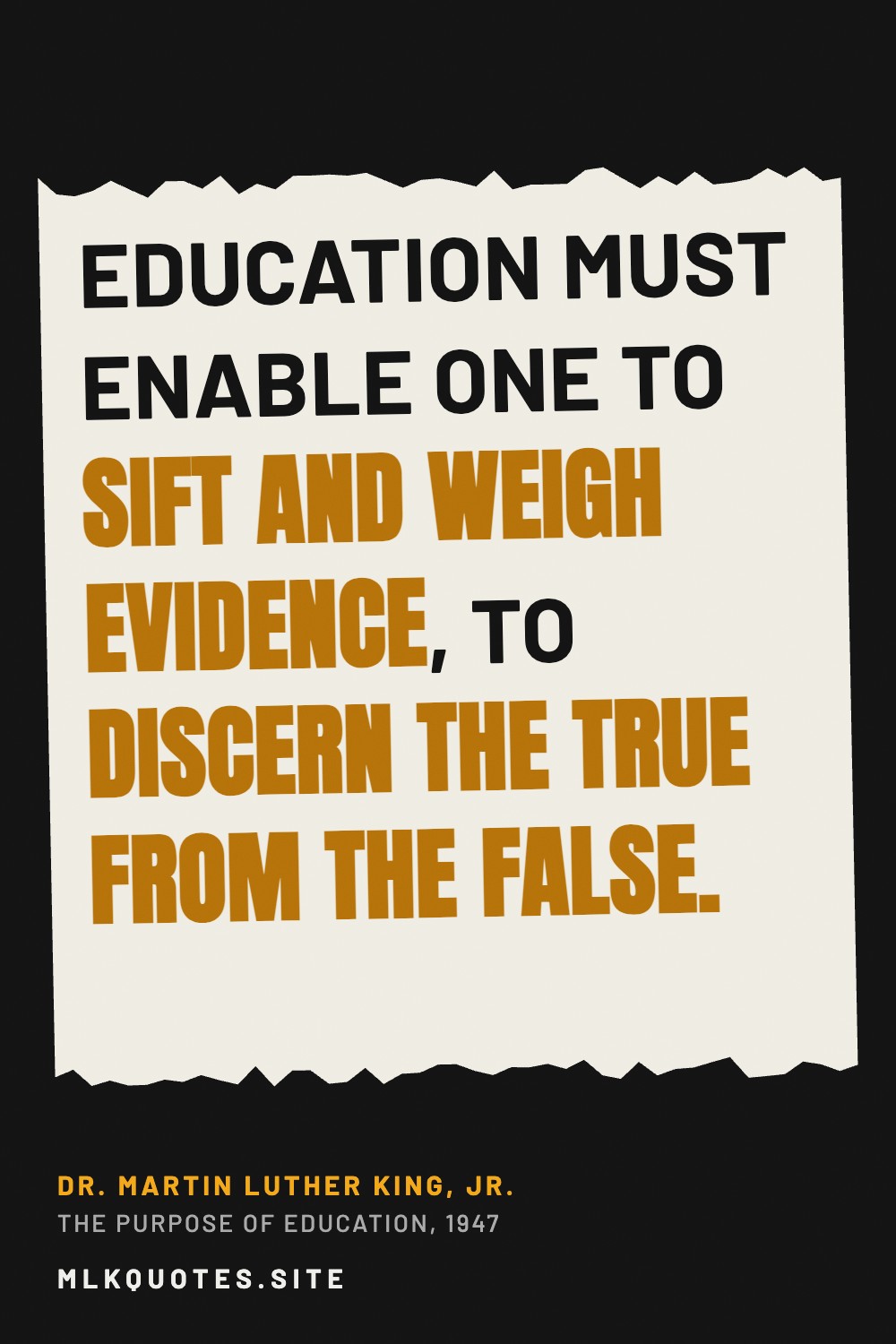
Quote image: “Education must enable one to sift and weigh evidence, to discern the true from the false.” Martin Luther King Jr., The Purpose of Education, 1947.

“Education must enable one to sift and weigh evidence, to discern the true from the false.”

The Purpose of Education, 1947

Save
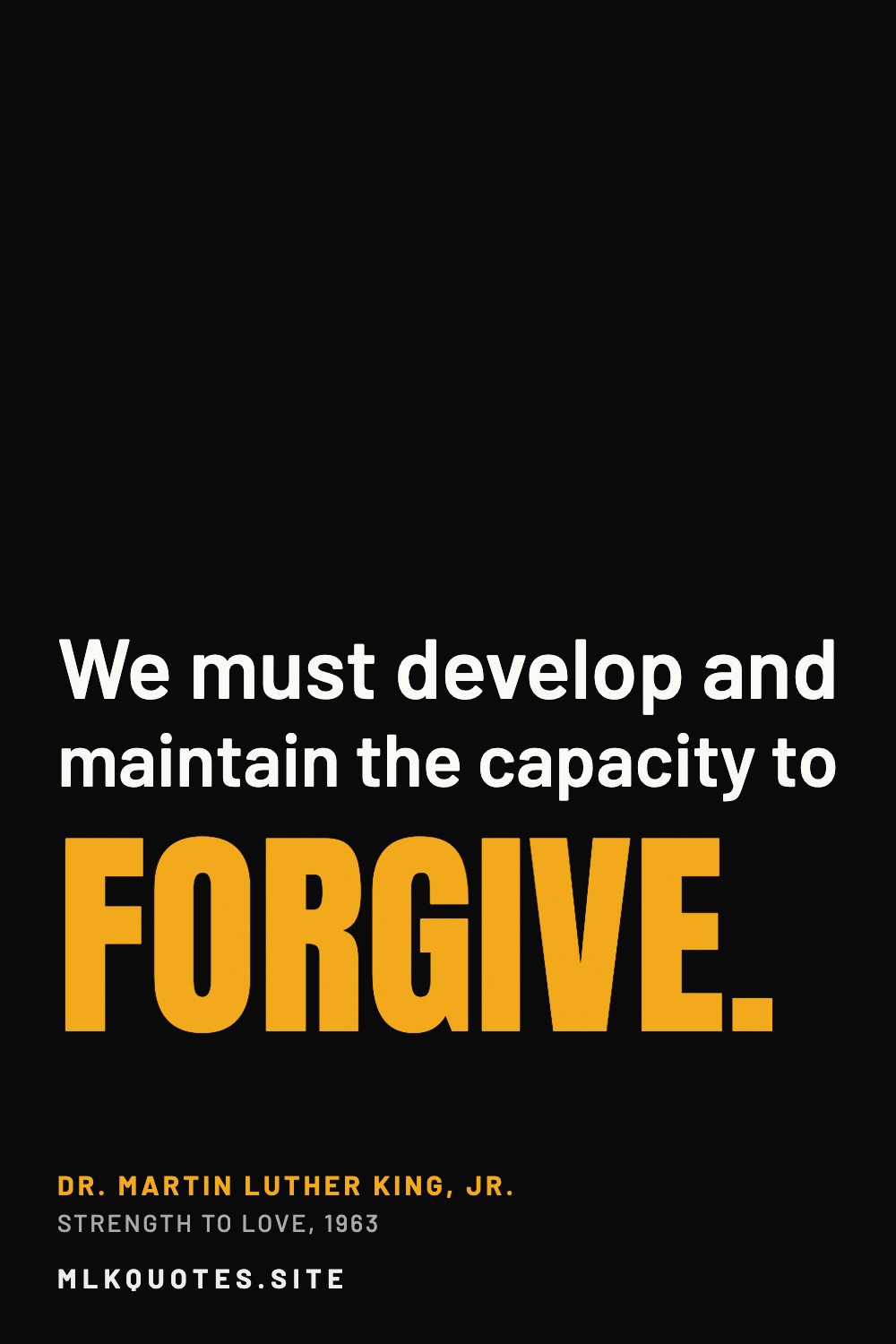
Quote image: “We must develop and maintain the capacity to forgive.” Martin Luther King Jr., Strength to Love, 1963.

“We must develop and maintain the capacity to forgive.”

Strength to Love, 1963

Save
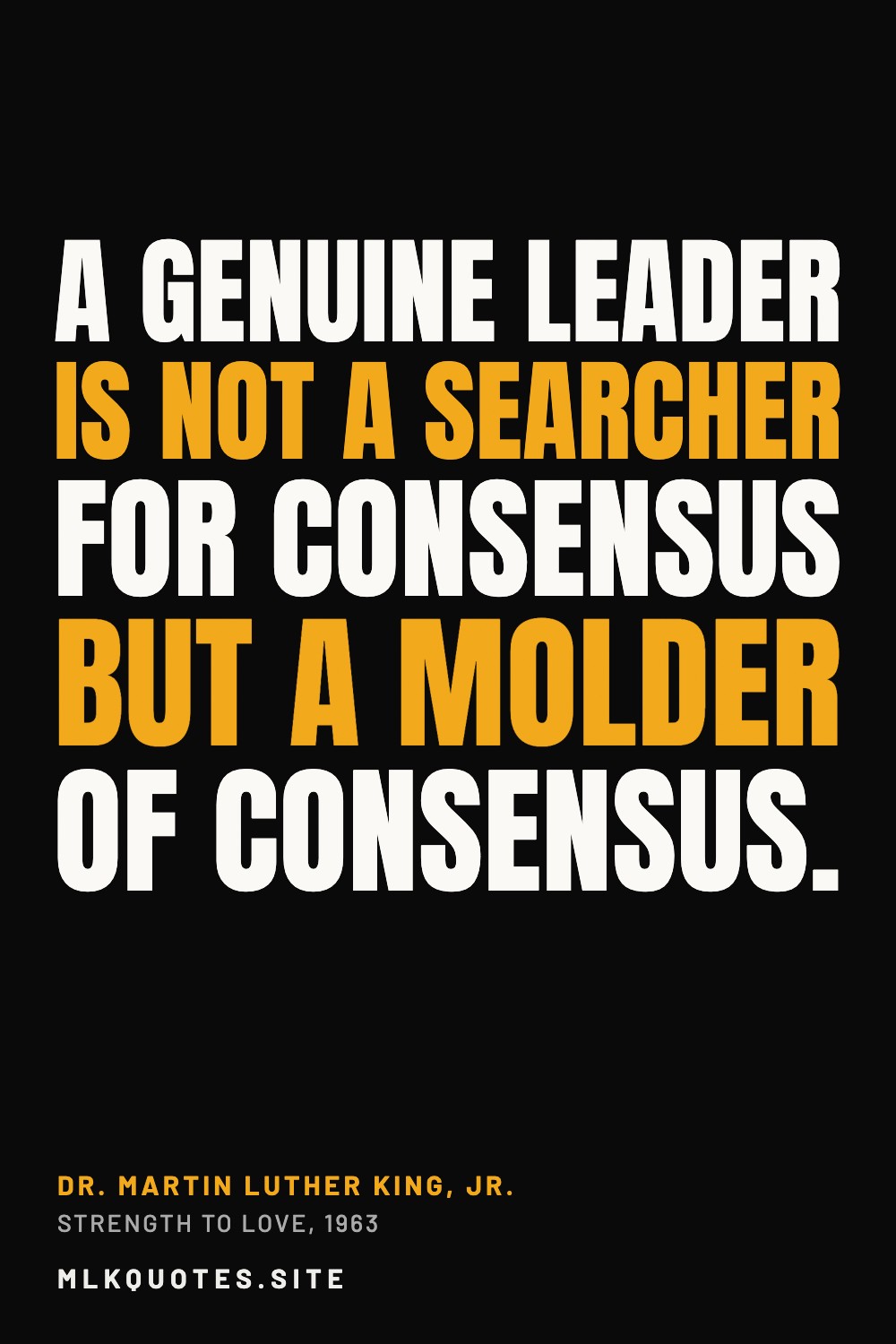
Quote image: “A genuine leader is not a searcher for consensus but a molder of consensus.” Martin Luther King Jr., Strength to Love, 1963.

“A genuine leader is not a searcher for consensus but a molder of consensus.”

Strength to Love, 1963

Save
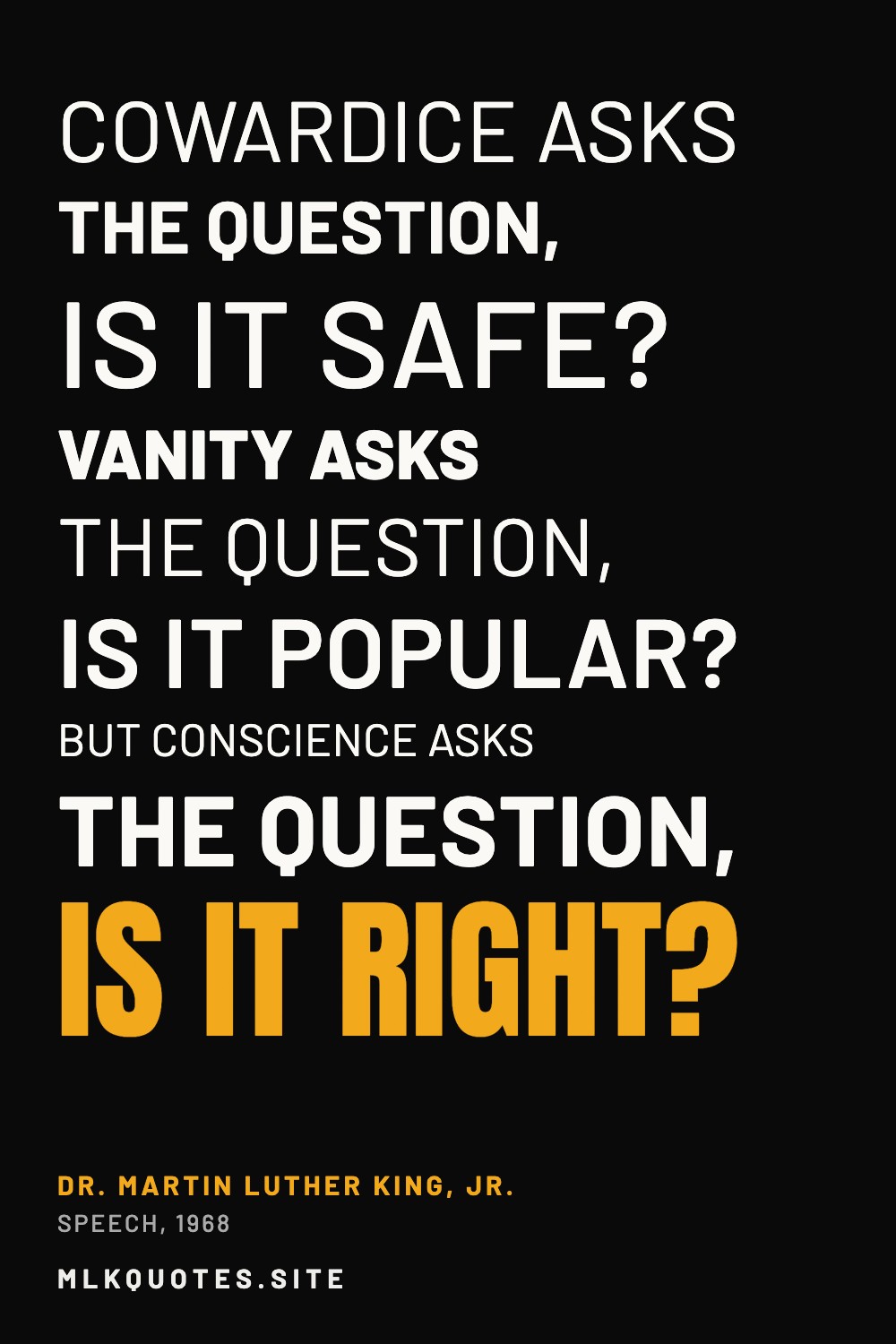
Quote image: “Cowardice asks the question, is it safe? Vanity asks the question, is it popular? But conscience asks the question, is it right?” Martin Luther King Jr., Speech, 1968.

“Cowardice asks the question, is it safe? Vanity asks the question, is it popular? But conscience asks the question, is it right?”

Speech, 1968

Save
Quote image: “Cowardice asks the question, is it safe? Expediency asks the question, is it politic? Vanity asks the question, is it popular? But conscience asks the question, is it right?” Martin Luther King Jr., Speech, 1968.

“Cowardice asks the question, is it safe? Expediency asks the question, is it politic? Vanity asks the question, is it popular? But conscience asks the question, is it right?”

Speech, 1968

Save
Quote image: “We must remember that intelligence is not enough. Intelligence plus character, that is the goal of true education.” Martin Luther King Jr., The Purpose of Education, 1947.

“We must remember that intelligence is not enough. Intelligence plus character, that is the goal of true education.”

The Purpose of Education, 1947

Save
Quote image: “The function of education, therefore, is to teach one to think intensively and to think critically.” Martin Luther King Jr., The Purpose of Education, 1947.

“The function of education, therefore, is to teach one to think intensively and to think critically.”

The Purpose of Education, 1947

Save
Quote image: “Like anybody, I would like to live a long life. Longevity has its place. But I'm not concerned about that now.” Martin Luther King Jr., I've Been to the Mountaintop, 1968.

“Like anybody, I would like to live a long life. Longevity has its place. But I'm not concerned about that now.”

I've Been to the Mountaintop, 1968

Save

A student’s first argument

King was about eighteen when the Maroon Tiger, Morehouse College’s student paper, printed his essay “The Purpose of Education.” The King Papers Project dates it to January–February 1947 (King Papers). His point was that reasoning ability isn’t enough on its own. A clever person with no moral compass can do great harm, and the essay names a Georgia politician as its example. Education, he wrote, has to produce character as well as intelligence.

Greatness redefined

Twenty-one years later, on 4 February 1968, he preached “The Drum Major Instinct” at Ebenezer Baptist Church in Atlanta. The sermon takes the human wish to lead the parade and turns it toward service: you don’t need a college degree or perfect grammar to serve, only “a heart full of grace, a soul generated by love.” In the same sermon he described what he’d like said at his own funeral. Excerpts were played at that funeral, at Ebenezer, on 9 April 1968 (King Institute).

Quoting these lines correctly

  • The education quote is often run together as one sentence. In the essay, “Intelligence plus character” comes several sentences after “to think intensively and to think critically,” so use an ellipsis if you quote both.
  • “Everybody can be great, because everybody can serve” says everybody twice. Versions with “anybody” are misquotes.

Frequently asked questions

What did MLK say about education?

In “The Purpose of Education,” published in the Morehouse student newspaper, the Maroon Tiger, in early 1947, he wrote: “The function of education, therefore, is to teach one to think intensively and to think critically.” Later in the same essay: “Intelligence plus character—that is the goal of true education” (King Papers).

What did MLK say about leadership and greatness?

In “The Drum Major Instinct,” preached at Ebenezer Baptist Church in Atlanta on 4 February 1968, he redefined greatness as service: “everybody can be great, because everybody can serve” (King Institute). Excerpts of that sermon were played at his funeral two months later.

Sources

  1. King Papers — “The Purpose of Education” (Maroon Tiger, 1947)
  2. King Institute — “Drum Major Instinct”

How this page was made: written with AI assistance from the primary sources listed above.Every quotation and fact was checked against those sources by Maddy on 6 October 2026. How we verify · Last updated 6 October 2026